
Pilates for Better Posture: Expert Techniques That Transform Your Spine
In today’s digital world, poor posture has become an epidemic. Whether you’re working from home in Buckhead or commuting to Midtown Atlanta offices, chances are you’re spending hours hunched over screens, creating what experts call “tech neck” and forward head posture. The good news? Pilates offers a scientifically-proven solution that can transform your spinal alignment, reduce pain, and boost your confidence in just weeks.
At Inspire Health, we’ve helped hundreds of Atlanta residents reclaim their posture through targeted Pilates techniques. Unlike quick fixes or temporary solutions, Pilates addresses the root cause of postural imbalances by strengthening your core, improving spinal mobility, and retraining your body’s natural alignment patterns.
Why Poor Posture Develops (And Why It Matters)
Poor posture doesn’t happen overnight—it’s the result of repetitive habits that gradually reshape our bodies. The average American spends over 7 hours daily in seated positions, according to the American Physical Therapy Association¹. This prolonged sitting creates a cascade of muscular imbalances:
- Tight hip flexors pull the pelvis forward
- Weakened glutes fail to support proper pelvic alignment
- Rounded shoulders from reaching toward keyboards and phones
- Forward head posture straining the cervical spine
For Atlanta’s active professionals, this creates a unique challenge. You might maintain an active lifestyle—hiking at Stone Mountain or cycling the Beltline—but eight hours of desk work can undo the benefits of weekend activities.
The health impacts extend far beyond aesthetics. Research published in the Journal of Physical Therapy Science shows that poor posture contributes to:
- Chronic neck and back pain affecting 80% of adults²
- Reduced lung capacity by up to 30%³
- Decreased confidence and perceived competence in professional settings⁴
- Increased risk of disc herniation and nerve impingement
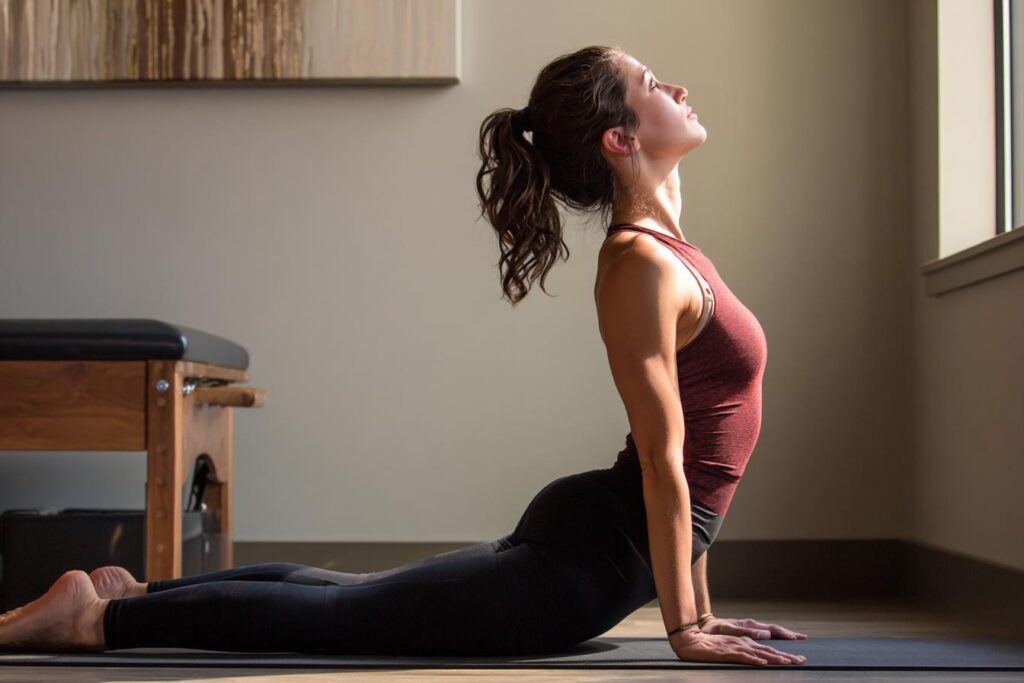
The Pilates Approach to Postural Alignment
Pilates was originally developed by Joseph Pilates as “Contrology”—a method of controlled, precise movements that retrain the body’s natural movement patterns. Unlike traditional exercise that focuses on individual muscle groups, Pilates works on integrated movement patterns that directly address postural dysfunction.
The core principles that make Pilates uniquely effective for posture correction include:
Core Stabilization
True core strength goes beyond “six-pack” abs. Pilates targets the deep stabilizing muscles—the transverse abdominis, multifidus, and pelvic floor—that act like an internal corset supporting your spine. Harvard Health Publishing research confirms that a strong deep core is essential for maintaining neutral spinal alignment⁵.
Spinal Articulation
Many people move their spine as one rigid unit. Pilates teaches segmental spinal movement, where each vertebra moves independently. This mobility prevents stiffness and allows for natural spinal curves that support healthy posture.
Postural Awareness
The mind-body connection emphasized in Pilates helps you develop proprioception—awareness of your body’s position in space. This heightened awareness allows you to self-correct postural habits throughout your day.
Balanced Muscle Development
Pilates specifically targets the posterior chain muscles (back body) that are often weak in people with poor posture, while stretching the anterior muscles that tend to be tight and overactive.
Essential Pilates Exercises for Better Posture
These five foundational exercises form the cornerstone of postural correction. When performed consistently with proper form, they can dramatically improve your alignment within 4-6 weeks.
The Hundred: Building Core Endurance
The Hundred is Pilates’ signature breathing exercise that builds the stamina your core muscles need to support good posture all day long.
How to perform:
- Lie on your back, knees bent at 90 degrees
- Lift your head and shoulders, reaching arms long by your sides
- Pump arms vigorously while breathing in for 5 counts, out for 5 counts
- Complete 10 breath cycles (100 pumps total)
Postural benefits: Strengthens deep abdominals while teaching proper breathing patterns that support spinal alignment.
Roll Up: Spinal Articulation Mastery
This exercise teaches your spine to move vertebra by vertebra, creating the mobility necessary for healthy posture.
How to perform:
- Lie flat with arms reaching toward ceiling
- Slowly peel your spine off the mat, one vertebra at a time
- Roll forward over your legs with arms reaching toward feet
- Reverse the movement, rolling down with control
Postural benefits: Improves spinal flexibility while strengthening the core muscles that maintain neutral spine position.
Swan Prep: Posterior Chain Activation
Many posture problems stem from weak back muscles. Swan Prep specifically targets the erector spinae and rhomboids that pull your shoulders back and support natural spinal curves.
How to perform:
- Lie face down with palms under forehead
- Engage your core and slowly lift chest and head
- Pull shoulder blades down and back
- Hold for 3-5 seconds, then lower with control
Postural benefits: Strengthens the entire back body while creating awareness of proper shoulder blade positioning.
Wall Sits: Postural Reset
This exercise helps you experience what proper alignment feels like, making it easier to maintain throughout your day.
How to perform:
- Stand with your back against a wall
- Walk feet slightly forward, maintaining wall contact at head, shoulders, and tailbone
- Hold for 30-60 seconds, breathing normally
- Focus on the feeling of proper alignment
Postural benefits: Provides immediate feedback on neutral spine position and activates postural muscles.
Shoulder Blade Slides: Upper Body Integration
Forward head posture often accompanies rounded shoulders. This exercise specifically addresses upper body alignment.
How to perform:
- Stand with back against wall, arms in “goal post” position
- Maintain wall contact while sliding arms up and down
- Focus on keeping shoulder blades connected to ribs
- Perform 8-10 repetitions slowly
Postural benefits: Strengthens lower trapezius and serratus anterior while improving shoulder blade mobility and control.
Finding the Right Pilates Program in Atlanta
While these exercises provide a foundation, working with qualified instructors is crucial for lasting postural change. Our expert Pilates instructors at Inspire Health are trained to identify your specific imbalances and create personalized correction strategies.
Individual vs. Group Classes for Posture Work
For severe postural dysfunction, we often recommend starting with private sessions. This allows for:
- Detailed postural assessment and movement analysis
- Customized exercise modifications based on your limitations
- One-on-one correction and cueing
- Integration with physical therapy when needed
Group classes become highly beneficial once you’ve established proper movement patterns. The community aspect helps maintain consistency, and seeing others’ progress provides motivation.
What to Expect in Your First Session
Your initial Pilates consultation includes:
- Comprehensive postural assessment
- Movement screening to identify restrictions
- Discussion of daily habits and work setup
- Customized exercise plan with home practice recommendations
- Timeline and realistic expectations for improvement
Most clients notice increased body awareness within 2-3 sessions. Measurable postural improvements typically occur within 4-6 weeks of consistent practice (2-3 sessions per week).
Transform Your Posture, Transform Your Life
Good posture is more than just standing up straight—it’s about creating a strong, resilient body that supports you through all of life’s activities. Whether you’re presenting in boardrooms, playing with your children, or enjoying Atlanta’s outdoor activities, proper alignment enhances everything you do.
The techniques outlined above provide a starting point, but lasting change requires consistent practice and expert guidance. At Inspire Health, we’re committed to helping you not just improve your posture, but develop the strength and awareness to maintain it for life.
Ready to transform your posture? Schedule a consultation with our expert Pilates instructors in Atlanta to create your personalized posture improvement plan. Your spine—and your confidence—will thank you.
References:
- American Physical Therapy Association. “Physical Activity and Exercise Guidelines.” 2023.
- Journal of Physical Therapy Science. “Effects of exercise program on postural stability.” 2022; 34(8): 545-551.
- European Respiratory Journal. “The effect of posture on respiratory function.” 2021; 58(4): 123-130.
- Health Psychology. “Body posture affects confidence and risk tolerance.” 2020; 39(6): 789-796.
- Harvard Health Publishing. “Core exercises: Why you should strengthen your core muscles.” Harvard Medical School, 2023.