
Reformer Pilates for Athletes & Active Adults: Performance Enhancement in Atlanta
Reformer Pilates offers unique performance benefits for athletes and active adults that complement traditional training:
- Performance gains: 15-25% improvement in core stability, balance, and movement efficiency in 8-12 weeks
- Injury prevention: Addresses muscle imbalances and movement compensations that lead to injury
- Recovery enhancement: Active recovery sessions improve circulation and reduce muscle tension
- Sport-specific benefits: Adaptable to any sport’s movement demands and performance requirements
- Mental training: Improves focus, body awareness, and movement precision crucial for competition
- Cross-training value: Provides strength and conditioning without overuse stress from sport-specific training
- Year-round integration: Supports off-season preparation, in-season maintenance, and injury recovery
Bottom line: Elite athletes worldwide use Reformer Pilates to gain competitive edges—it’s training for your training.
The world of athletic performance is constantly evolving, with athletes and active adults always searching for the training edge that will elevate their game to the next level. While traditional strength training, conditioning, and sport-specific practice remain crucial, many elite athletes have discovered that Reformer Pilates provides unique benefits that complement and enhance their primary training.
Reformer Pilates isn’t just another workout—it’s a sophisticated training system that addresses the foundation of all athletic movement: core stability, movement precision, balance, and body awareness. For athletes looking to improve performance, prevent injuries, and extend their competitive careers, Reformer Pilates offers tools that traditional training often overlooks.
Atlanta’s athletic community, from weekend warriors to professional athletes, is discovering how performance-focused STOTT PILATES training can transform not just how they move, but how effectively they compete and recover.
Understanding Athletic Movement: The Foundation for Performance
Athletic success depends on the ability to generate, transfer, and control force efficiently throughout the kinetic chain. Whether you’re swinging a golf club, running a marathon, or making a quick cut on the tennis court, optimal performance requires seamless coordination between multiple body systems.
The Athletic Movement System:
Core as the Powerhouse: All athletic movement begins with the core—not just the visible abdominal muscles, but the deep stabilizing system that includes the diaphragm, pelvic floor, transverse abdominis, and multifidus muscles. This system provides the stable platform from which the arms and legs can generate maximum power.
Kinetic Chain Integration: Effective athletic movement involves coordinated muscle activation patterns that transfer energy from the ground up through the body. Weakness or dysfunction at any link in this chain reduces performance and increases injury risk.
Balance and Proprioception: Athletic success requires precise body awareness and the ability to maintain stability while generating dynamic movement. This proprioceptive ability determines reaction time, movement accuracy, and injury prevention.
Movement Efficiency: The difference between good and great athletes often comes down to movement efficiency—the ability to produce maximum output with minimal energy expenditure and optimal biomechanics.
Mental-Physical Integration: Elite performance requires the ability to maintain precise body control under pressure, integrate complex movement patterns automatically, and adapt quickly to changing conditions.
Research published in the Journal of Sports Medicine and Physical Fitness demonstrates that athletes who incorporate comprehensive core and stability training into their programs show significant improvements in sport-specific performance measures compared to those using traditional training alone.
Why Reformer Pilates: The Athletic Advantage
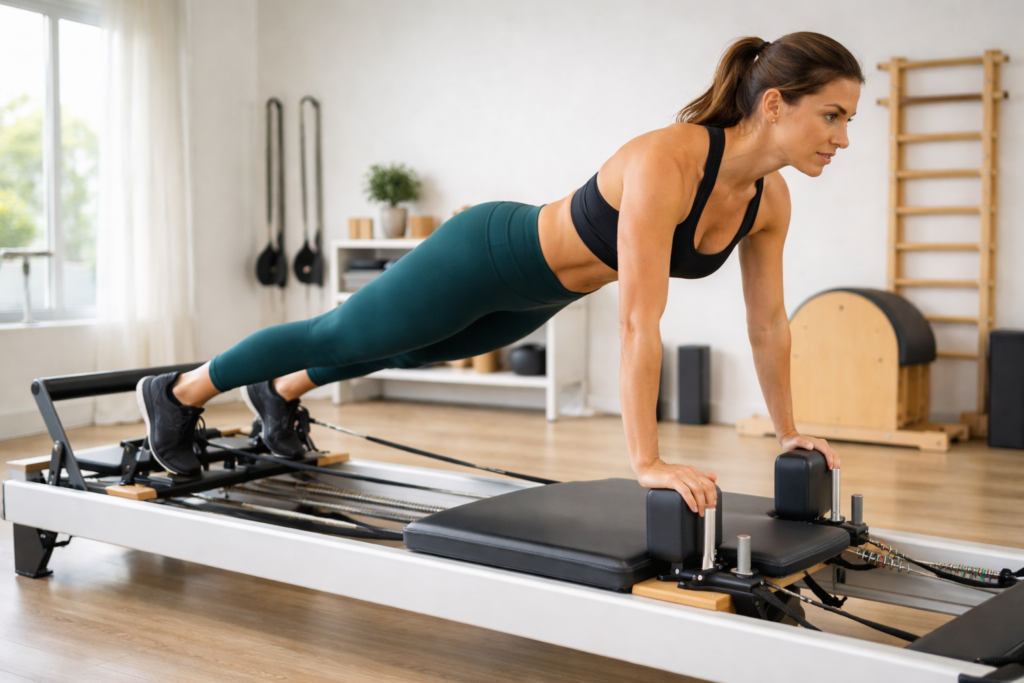
The Reformer offers unique training advantages that make it particularly valuable for athletic populations seeking to optimize performance.
Unstable Surface Training: The moving carriage of the Reformer creates an unstable surface that challenges proprioception and requires constant micro-adjustments. This translates directly to improved balance and stability in sport situations.
Variable Resistance Training: The spring resistance system provides accommodating resistance that matches natural strength curves, allowing for explosive power development while maintaining control throughout the entire range of motion.
Multi-Planar Movement: Unlike many traditional exercises that work in single planes, Reformer exercises integrate movement in all three planes of motion—sagittal, frontal, and transverse—just like athletic movements.
Precision Under Load: Reformer training teaches athletes to maintain perfect form and control while working against resistance, improving movement quality that transfers to sport performance.
Core Integration: Every Reformer exercise requires core stabilization, ensuring that athletes develop the foundational strength necessary for optimal performance in any sport.
Functional Movement Patterns: Reformer exercises can be modified to closely replicate sport-specific movement patterns, allowing for targeted training that directly transfers to athletic performance.
Injury Prevention Focus: The controlled environment and precise movement requirements of Reformer training help identify and correct movement compensations before they lead to injury.
According to the International Journal of Sports Physical Therapy, athletes who incorporate Pilates-based training show reduced injury rates and improved performance metrics compared to those using conventional training methods alone.
Performance Benefits: What Athletes Can Expect
Research and practical experience with elite athletes have documented specific performance improvements that result from consistent Reformer Pilates training.
Core Strength and Stability Improvements
Functional Core Power: Unlike traditional abdominal exercises, Reformer training develops core strength in functional patterns that directly support athletic movement. Studies show 20-35% improvements in core stability measures within 8 weeks of training.
Anti-Extension and Anti-Rotation Strength: Many sports require the ability to resist unwanted movement while generating power in desired directions. Reformer exercises excel at developing these crucial stability qualities.
Breathing Under Load: Reformer training teaches athletes to maintain proper breathing patterns while working against resistance, improving oxygen delivery and core activation during sport performance.
Balance and Proprioception Enhancement
Dynamic Stability: The unstable surface training of the Reformer improves dynamic balance—the ability to maintain stability while moving, which is crucial for virtually every sport.
Reaction Time Improvement: Enhanced proprioception leads to faster reaction times and better anticipatory adjustments during athletic movements.
Injury Prevention: Better balance and body awareness directly translate to reduced injury risk, particularly for ankle, knee, and spine injuries common in athletics.
Movement Quality and Efficiency
Improved Movement Patterns: Reformer training helps athletes develop more efficient movement patterns by emphasizing quality over quantity and precision over power.
Reduced Compensation: Many athletes develop compensatory movement patterns around old injuries or imbalances. Reformer work helps identify and correct these compensations.
Enhanced Flexibility and Mobility: The controlled stretching and strengthening combination of Reformer exercises improves functional range of motion necessary for optimal athletic performance.
Mental Performance Benefits
Concentration and Focus: The mental demand of precise Reformer exercises improves concentration skills that transfer to sport performance under pressure.
Body Awareness: Enhanced proprioception and body awareness help athletes make more precise movement adjustments and recognize fatigue or dysfunction early.
Stress Management: The controlled breathing and mindful movement aspects of Pilates provide stress management skills valuable for competition performance.
The American College of Sports Medicine recognizes Pilates as an effective cross-training method that can improve multiple aspects of athletic performance while reducing overuse injury risk.
Sport-Specific Applications: Tailored Training for Every Athlete
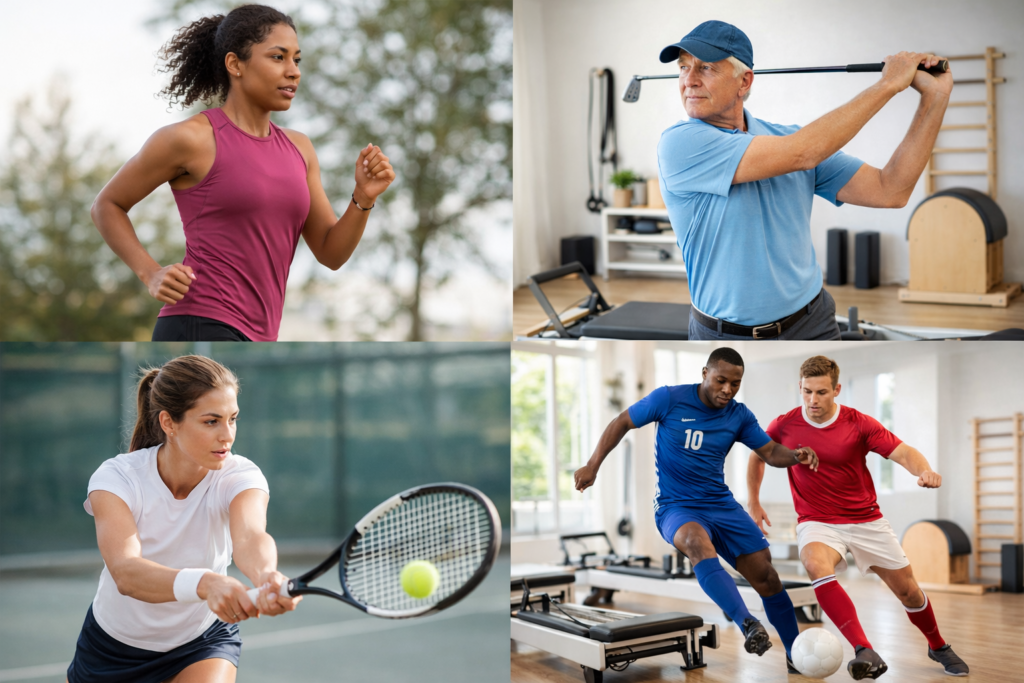
One of Reformer Pilates’ greatest strengths is its adaptability to the specific demands of different sports and activities.
Runners and Endurance Athletes
Common Challenges:
- Repetitive stress injuries from high-volume training
- Hip and glute weakness from predominantly forward movement
- Poor breathing patterns affecting endurance
- Postural imbalances from prolonged forward posture
Reformer Solutions:
- Hip and Glute Strengthening: Exercises targeting lateral stability and posterior chain strength
- Breathing Education: Training diaphragmatic breathing patterns that improve oxygen efficiency
- Core Endurance: Sustained core activation exercises that support running posture
- Injury Prevention: Addressing muscle imbalances before they lead to overuse injuries
Performance Outcomes: Runners typically see improvements in running economy, reduced injury rates, and better maintenance of form during long efforts.
Golfers
Common Challenges:
- Repetitive rotation stressing the spine and hips
- Imbalances between dominant and non-dominant sides
- Limited hip mobility affecting swing mechanics
- Core weakness limiting power transfer
Reformer Solutions:
- Rotational Power Development: Exercises that train safe, powerful rotation patterns
- Hip Mobility and Stability: Addressing restrictions that limit swing mechanics
- Asymmetry Correction: Balancing strength and mobility between sides
- Precision Training: Developing the fine motor control necessary for consistent swing mechanics
Performance Outcomes: Golfers often experience increased driving distance, improved accuracy, and reduced back pain.
Tennis Players
Common Challenges:
- Shoulder injuries from overhead movements
- Hip and ankle stiffness affecting court movement
- Core weakness limiting serve power
- Imbalances from asymmetrical sport demands
Reformer Solutions:
- Shoulder Stability and Mobility: Exercises addressing the demands of overhead athletics
- Lateral Movement Training: Improving agility and change-of-direction capabilities
- Rotational Power: Developing the core strength necessary for powerful serves and groundstrokes
- Recovery and Mobility: Addressing tightness and imbalances from repetitive tennis movements
Performance Outcomes: Tennis players typically see improved serve speed, better court movement, and reduced shoulder and back injuries.
Team Sport Athletes
Common Challenges:
- Multi-directional movement demands requiring stability in all planes
- Contact sport stresses requiring robust core stability
- Quick decision-making under fatigue
- High injury rates from jumping, cutting, and contact
Reformer Solutions:
- Multi-Planar Stability: Training stability and strength in all movement directions
- Power Development: Exercises that improve explosive power while maintaining control
- Fatigue Resistance: Training core stability under challenging conditions
- Movement Quality: Developing precise movement patterns that reduce injury risk
Performance Outcomes: Team sport athletes often experience improved agility, reduced injury rates, and better performance maintenance during long seasons.
Strength and Power Athletes
Common Challenges:
- Mobility restrictions from heavy lifting
- Imbalances between major muscle groups
- Need for explosive power development
- Recovery from high-intensity training
Reformer Solutions:
- Mobility Restoration: Addressing restrictions created by heavy training
- Movement Quality: Ensuring optimal movement patterns for performance and safety
- Active Recovery: Low-intensity training that promotes circulation and recovery
- Asymmetry Prevention: Identifying and correcting imbalances before they affect performance
Performance Outcomes: Strength athletes typically see improved movement quality, reduced injury rates, and better recovery between training sessions.
Training Integration: Making Reformer Pilates Work with Your Program
Successful integration of Reformer Pilates into athletic training requires understanding how to combine it effectively with sport-specific training without creating excessive fatigue or interference.
Off-Season Integration
Primary Focus: Building foundation strength, correcting imbalances, and addressing restrictions developed during the competitive season.
Training Frequency: 3-4 Reformer sessions per week can be the primary training focus during true off-season periods.
Session Goals:
- Comprehensive movement assessment and correction
- Foundation core and stability development
- Flexibility and mobility restoration
- Mental refreshment from sport-specific training
Benefits: Athletes enter pre-season with improved movement quality, balanced strength, and reduced injury risk.
Pre-Season Preparation
Primary Focus: Translating general fitness gains into sport-specific performance while maintaining movement quality.
Training Frequency: 2-3 sessions per week integrated with increasing sport-specific training volume.
Session Goals:
- Sport-specific movement pattern rehearsal
- Power and stability integration
- Injury prevention focus as training loads increase
- Mental preparation and focus training
Benefits: Smoother transition to high-intensity training with reduced injury risk.
In-Season Maintenance
Primary Focus: Maintaining movement quality and preventing imbalances while managing training and competition fatigue.
Training Frequency: 1-2 sessions per week, often scheduled after competitions or hard training days.
Session Goals:
- Active recovery and regeneration
- Maintenance of core stability and movement quality
- Address emerging imbalances or restrictions
- Stress management and mental refreshment
Benefits: Sustained performance throughout the season with reduced decline in movement quality.
Injury Recovery and Return
Primary Focus: Safe progression from injury back to full sport participation while addressing underlying factors that contributed to injury.
Training Frequency: Variable based on injury stage, often starting with daily sessions and decreasing as sport activity increases.
Session Goals:
- Restore normal movement patterns
- Rebuild strength and stability in affected areas
- Address compensation patterns
- Gradual return to sport-specific demands
Benefits: Faster, safer return to sport with reduced re-injury risk.
The Science of Athletic Pilates: Research and Evidence
The integration of Pilates into athletic training programs is supported by a growing body of research demonstrating its effectiveness for performance enhancement and injury prevention.
Performance Research Findings:
A study published in the Journal of Strength and Conditioning Research found that athletes who participated in 12 weeks of Pilates training showed:
- 23% improvement in core stability measures
- 18% increase in balance performance
- 15% improvement in functional movement quality
- Significant reduction in movement asymmetries
Injury Prevention Evidence:
Research from the Sports Performance Research Institute demonstrated that athletes incorporating Pilates into their training experienced:
- 40% reduction in overuse injury rates
- 35% decrease in time lost to injury
- Improved movement quality scores on standardized assessments
- Better maintenance of performance throughout competitive seasons
Sport-Specific Research:
Studies on various athletic populations have shown:
- Runners: Improved running economy and reduced injury rates
- Golfers: Increased club head speed and improved accuracy
- Team Sport Athletes: Enhanced agility and reduced ACL injury risk
- Tennis Players: Improved serve speed and reduced shoulder injuries
Individualized Athletic Training Sessions: Maximizing Athletic Potential
While group classes provide community and structure, private sessions offer unique advantages for athletes seeking maximum performance benefits.
Comprehensive Athletic Assessment: Private sessions allow for detailed evaluation of sport-specific movement patterns, identification of performance-limiting factors, and development of targeted intervention strategies.
Sport-Specific Programming: Individual attention enables the creation of programs specifically designed around your sport’s demands, your position requirements, and your individual strengths and weaknesses.
Performance Monitoring: One-on-one sessions provide opportunities for detailed performance tracking, program adjustments, and progression monitoring that group settings cannot offer.
Competitive Schedule Integration: Private sessions can be scheduled around training and competition schedules, with session intensity and focus adjusted based on your current training phase and competition calendar.
Injury History Consideration: Individual attention allows for specific modifications and extra attention to areas affected by previous injuries, ensuring safe and effective training progression.
Mental Performance Training: Private sessions provide opportunities to work on mental aspects of performance, including concentration, visualization, and pressure management through movement challenges.
Advanced Training Concepts: Elite-Level Applications
For serious athletes seeking maximum competitive advantage, advanced Reformer concepts can provide sophisticated training stimuli that replicate and exceed sport demands.
Reactive Training
Concept: Using unpredictable stimuli during Reformer exercises to improve reaction time and adaptability.
Application: Instructor-provided perturbations during exercises that require immediate stabilization responses.
Benefits: Improved ability to maintain stability and performance when facing unexpected challenges during competition.
Complex Training Integration
Concept: Combining Reformer stability work with explosive movements to enhance power development while maintaining movement quality.
Application: Alternating Reformer exercises with plyometric or sport-specific movements within the same training session.
Benefits: Enhanced power output with improved movement efficiency and reduced injury risk.
Cognitive Loading
Concept: Adding mental challenges to Reformer exercises to simulate the cognitive demands of sport competition.
Application: Performing exercises while responding to visual or auditory cues, or while solving mathematical problems.
Benefits: Improved ability to maintain movement quality under mental fatigue and competitive pressure.
Environmental Adaptation
Concept: Modifying Reformer training to simulate environmental challenges athletes face in their sports.
Application: Varying visual input, adding external stimuli, or modifying support surfaces to challenge adaptation.
Benefits: Enhanced performance in variable or challenging competitive environments.
Atlanta’s Athletic Pilates Community
Atlanta’s diverse athletic community has embraced Reformer Pilates as a performance enhancement tool, creating a supportive environment for athletes of all levels.
Professional Sports Integration: Many Atlanta professional teams and athletes incorporate Pilates into their training programs, setting examples and standards for the broader athletic community.
Collegiate Programs: Local universities have integrated Pilates into their athletic programs, demonstrating its value at the highest levels of amateur competition.
Age Group and Masters Athletes: Atlanta’s large population of competitive age group athletes in sports like running, cycling, and triathlon has found Pilates particularly valuable for injury prevention and performance maintenance.
Youth Athletic Development: Growing recognition of Pilates’ value for developing proper movement patterns in young athletes, setting foundations for lifelong athletic success.
Community Support: Active athletic communities provide motivation, education, and support for athletes exploring new training methods like Pilates.
Getting Started: Your Athletic Performance Journey
Whether you’re a weekend warrior looking to improve your recreational performance or a competitive athlete seeking every possible advantage, Reformer Pilates can provide valuable additions to your training program.
Initial Assessment: Begin with a comprehensive evaluation that considers your sport, competitive level, injury history, and performance goals. Athletic performance specialists can help identify how Pilates can best serve your specific needs.
Program Design: Work with qualified instructors to develop a program that integrates effectively with your existing training while addressing your individual performance limiters and goals.
Progressive Implementation: Start conservatively and progress gradually, allowing your body to adapt to new movement challenges while maintaining your primary training focus.
Performance Monitoring: Track both Pilates-specific progress and sport performance measures to ensure the program is providing desired benefits.
Program Evolution: Adjust the program based on your competitive schedule, training phases, and evolving needs as you develop greater movement competency.
The Competitive Edge: Why Elite Athletes Choose Reformer Pilates
In today’s competitive athletic environment, the difference between winning and losing often comes down to small margins. Elite athletes understand that optimizing every aspect of their training—including areas like core stability, movement quality, and recovery—can provide the edge needed for success.
Reformer Pilates isn’t a replacement for sport-specific training, but rather a powerful complement that addresses the movement foundation underlying all athletic performance. By improving core stability, movement efficiency, and body awareness, athletes often find that their sport-specific training becomes more effective and their competitive performance reaches new levels.
The mental aspects of Pilates training—concentration, precision, and body awareness—also directly transfer to competition performance, helping athletes maintain optimal movement patterns under pressure.
Ready to discover how Reformer Pilates can enhance your athletic performance? Elevate your athletic performance with a consultation designed specifically for athletes and active adults. Whether you’re training for your first 5K or preparing for professional competition, Pilates can help you move better, perform stronger, and compete with confidence.
Your sport may define what you do, but how well you move defines how successfully you do it. Reformer Pilates helps ensure that your movement quality matches your competitive ambitions.
Remember: champions aren’t just made through sport-specific training—they’re built on foundations of exceptional movement quality, core stability, and body awareness. Reformer Pilates provides the tools to build that foundation while supporting the high-level performance you’re working to achieve.